Dewey's Readers
"The Non-fiction That Reads Like Fiction" Book Group
Meets the 3rd Wednesday of every Month @ 4:00 PM
There is No Place for Us: working and homeless in America - by Brian Coldstone
Wednesday, September 16th
4:00 p.m.
Green Room
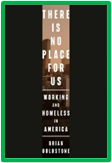
WINNER OF THE PULITZER PRIZE
The working homeless. In a country where hard work and determination are supposed to lead to success, there is something scandalous about this phrase. But skyrocketing rents, low wages, and a lack of tenant rights have produced a startling phenomenon: People with full-time jobs cannot keep a roof over their head, especially in America’s booming cities, where rapid growth is leading to catastrophic displacement. These families are being forced into homelessness not by a failing economy but a thriving one.
In this gripping and deeply reported book, Brian Goldstone plunges readers into the lives of five Atlanta families struggling to remain housed in a gentrifying, increasingly unequal city. Each of them aspires to provide a decent life for their children—and each of them, one by one, joins the ranks of the nation’s working homeless.
By turns heartbreaking and urgent, There Is No Place for Us illuminates the true magnitude, causes, and consequences of the new American homelessness—and shows that it won’t be solved until housing is treated as a fundamental human right.
Island at the Edge of the World: the forgotten history of Easter Island - by Mike Pitts
Wednesday, October 21st
4:00 p.m.
Green Room
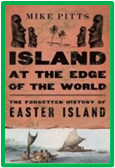
An archeologist reexamines the mystery of Rapa Nui—and offers answers.
Pitts, a British archaeologist and author, begins his latest book with a bold appeal: It is time to question everything we have been told about Rapa Nui.
For much of modern history, he tells us, this isolated island, located more than 2,000 miles west of Santiago, Chile, has been blamed for its own demise. Yet the familiar tales of war, cannibalism, and ecocide laced with judgment and condemnation have little grounding in historical truth. Instead, Pitts gives us a far more plausible account, in which slavery, kidnapping, and disease, driven by European conquest, are to blame. In Rapa Nui, the colonial playbook was catastrophically effective. It decimated the island nation in all but 15 years, during which its population plunged from 5,000 to little more than 100, with just 26 women. He instead asks us to reframe our line of inquiry from how things went wrong—after all, we now have answers—to how did the Rapa Nui flourish for so long? Their island is, according to Pitts, a place of fragile soil, restricted marine life, and no permanent freshwater streams. The answer lies in bravura skill in farming and land management. “Rapa Nui,” he says, “is the world’s greatest example of a people given lemons, and making lemonade.” Some of these insights come thanks to the pioneering work of British archeologist Katherine Routledge. Pitts gives readers an affectionate profile of her; she carried out extraordinary fieldwork and reporting during an expedition to the island in 1914, only to have her work questioned, and then overridden by the London establishment. Throughout his book, Pitts capably and passionately argues his case, though he occasionally veers into the perils of academic writing. The result is a welcome contribution to Pacific Island history that holds relevance not just for Rapa Nui, but for other islands across this vast ocean.
London Falling: a mysterious death in a gilded city and a family's search for truth
- by Patrick Radden Keefe
Wednesday, November 18th
4:00 p.m.
Green Room
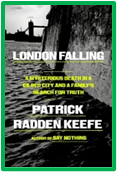
In the early morning of November 29th, 2019, surveillance cameras at the headquarters of MI6, Britain’s spy agency, captured video of a young man pacing back and forth on a high balcony of Riverwalk, a luxury tower on the bank of the river Thames. At 2:24 a.m., he jumped into the river.
In a quiet London neighborhood several miles away, Rachelle Brettler was worried about her son. Zac had told her that he had gone to stay with a friend for the weekend, but then he did not come home. Days later, a police car pulled up and two officers relayed the dreadful news: Her son was dead.
In their unbearable grief, Rachelle and her husband, Matthew, struggled to understand what had happened to Zac. He had had his troubles, but in no way seemed suicidal. As they would soon discover, however, there was a lot they did not know about their son. As the Brettlers set about investigating their son’s death, they were pulled into a different and more dangerous London than the one they’d always known, and came to believe that something much more nefarious than a suicide had claimed Zac’s life. But to their immense frustration, Scotland Yard seemed unable—or unwilling—to bring the perpetrators to justice.
In a bravura feat of reporting and writing, Patrick Radden Keefe chronicles the Brettlers’ quest, peeling back layers of mystery and exposing the seedy truths behind the glamorous London of posh mansions and private nightclubs, a city in which everything is for sale, and aspirational fantasies are underwritten by dirty money and corruption. London Falling is a mesmerizing investigation of an inexplicable death and a powerful narrative driven by suspense and staggering revelations. But it is also an intimate and deeply poignant inquiry into the nature of parental love and the challenges of being a parent today, a portrait of a family trying to solve the riddle not just of how their son died, but of who he really was in life.
